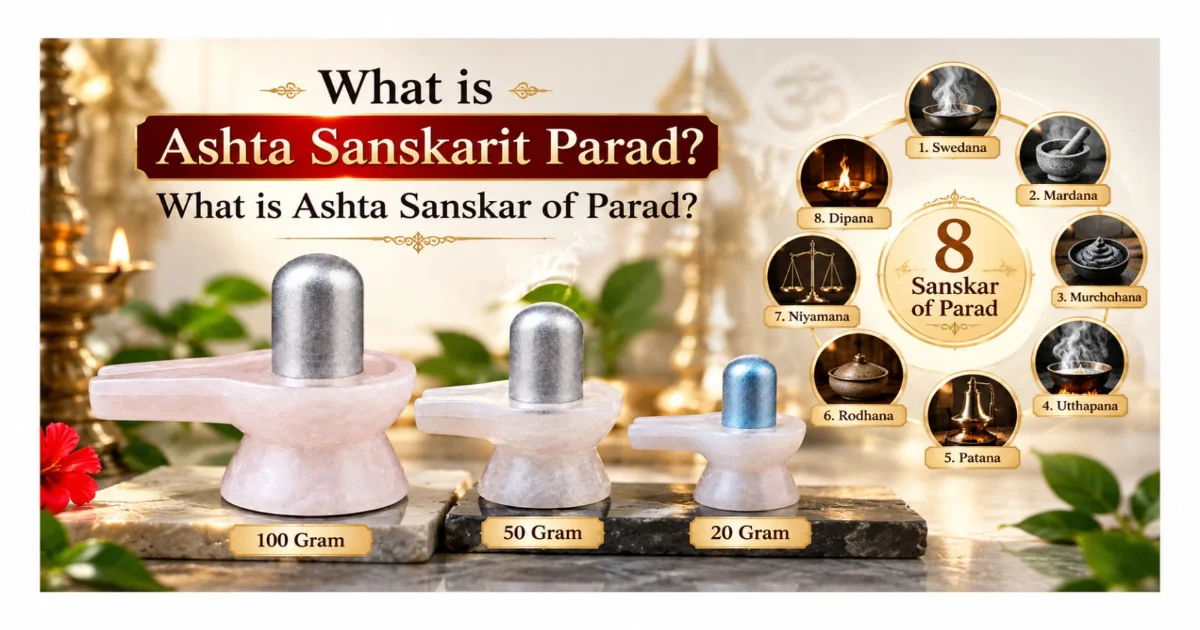
What is Ashta Sanskarit Parad? What is Ashta Sanskar of Parad?
Parad Shivling holds a special place in traditional Shaiva and Ras Shastra traditions. A Parad Shivling is traditionally prepared from processed Parad, and the process known as Ashta Sanskar is considered an important part of its traditional preparation.
What is Ashta Sanskar of Parad?
Ashta Sanskar means the eight traditional Sanskar or processing stages performed on Parad according to Ras Shastra traditions.
The eight traditional Sanskar are:
1. Swedana – A traditional processing stage involving controlled heating or steaming.
2. Mardana – Traditional grinding and processing of Parad with specified substances.
3. Murchchhana – A traditional stage of further processing and purification.
4. Utthapana – A traditional processing stage associated with further purification.
5. Patana – A traditional distillation-related process.
6. Rodhana – A traditional stage used in the further preparation of Parad.
7. Niyamana – A traditional regulating and purification process.
8. Dipana – The final traditional stage described in the preparation process.
The exact method, substances and sequence can vary according to traditional Ras Shastra texts and practices.
What is Ashta Sanskarit Parad?
Parad that has undergone the traditional eight Sanskar is known as Ashta Sanskarit Parad.
According to traditional belief, the purpose of these Sanskar is to purify and prepare Parad for its intended traditional applications. Therefore, Ashta Sanskarit Parad is traditionally distinguished from untreated or simply shaped Parad.
In the preparation of a Parad Shivling, traditionally processed Parad may be combined with Rajata Bhasma (silver ash) and formed into the Shivling using traditional preparation methods.
Why is Ashta Sanskar Important for Parad Shivling?
In traditional Ras Shastra and Shaiva practices, Ashta Sanskar is considered an important part of preparing Parad for worship.
A traditionally prepared Parad Shivling is believed to have undergone the required processing before being formed into the sacred Shivling.
The traditional preparation may involve combining Ashta Sanskarit Parad with Rajata Bhasma and carefully solidifying the material into the desired Shivling form.
Traditional Structure of Parad Shivling
According to the traditional information associated with Parad Shivling, a properly prepared Shivling may have a relatively uniform structure throughout.
If a Parad Shivling is broken, its internal texture may appear different from ordinary hard metal or steel-like imitation products. Traditional descriptions compare the internal consistency of properly prepared material to a dense, cement-like or dried-flour-like structure.
However, appearance alone should not be considered conclusive proof of authenticity.
Can a Genuine Parad Shivling Break?
Yes. A common misconception is that a genuine Parad Shivling can never break.
A traditionally prepared Parad Shivling can be damaged or broken if it is dropped, subjected to strong pressure or handled improperly.
Therefore, breakage by itself does not prove that a Parad Shivling is fake.
The composition and method of preparation are more important considerations when evaluating a Parad Shivling.
How is an Original Parad Shivling Traditionally Identified?
Various traditional descriptions are associated with the identification of Parad Shivling.
One traditional test describes rubbing the Shivling gently on the palm and observing whether it leaves a black or soot-like mark.
Traditional descriptions also associate genuine Parad Shivling with its specific composition and preparation rather than simply its external appearance.
Some imitation products may contain materials such as zinc, tin or other metals. Therefore, for a high-value Parad Shivling, proper material testing can provide more reliable information than relying only on traditional appearance-based tests.
Why Can Original Parad Shivling Cost More?
The preparation of Ashta Sanskarit Parad is traditionally considered a specialized and time-consuming process.
According to traditional practice, the Sanskar process and subsequent preparation of the Shivling can require considerable time, expertise and careful handling.
The price of a Parad Shivling may therefore depend on:
- Weight
- Size
- Composition
- Preparation process
- Craftsmanship
- Traditional processing
- Documentation
A higher price alone, however, should not be considered proof of authenticity.
Is a Lab Certificate Necessary?
A laboratory certificate can provide additional information about the material composition of a Parad Shivling.
However, providing an individual laboratory certificate with every Shivling can significantly increase the cost and preparation time of the product.
For valuable purchases, customers who require independent verification may choose to have the product examined by a suitable laboratory.
The laboratory report should be matched with the actual product being examined.
Traditional Significance of Parad Shivling
Parad Shivling is traditionally associated with Lord Shiva worship and is regarded as a sacred Shivling in Shaiva traditions.
Traditional beliefs associate Parad Shivling with:
- Shiva worship
- Spiritual practice
- Peace and positivity
- Prosperity and abundance
- Divine blessings
- Shiva and Lakshmi worship
- Protection from negative influences
These are traditional religious beliefs and should be understood within their respective spiritual traditions.
Final Thoughts
Ashta Sanskarit Parad refers to Parad that has undergone the traditional eight Sanskar described in Ras Shastra practices.
The Ashta Sanskar process is traditionally considered an important part of preparing Parad for the creation of a Parad Shivling. Traditionally prepared Parad may be combined with Rajata Bhasma and formed into a Shivling using specialized methods.
When choosing a Parad Shivling, customers should consider its composition, preparation method, seller information, product specifications and, where appropriate, independent material verification.
A genuine traditional Parad Shivling should not be judged only by its appearance, weight or whether it breaks. Understanding its traditional preparation and composition provides a more informed basis for selection.
Explore Parad Shivling products from Rudramani Gems & Rudraksha and review the available product specifications before making your selection.